The Real Cost of a Cable Is More Than Its Purchase Price
Imagine two cables for an automated machine.
-
Cable A costs $2 per meter.
-
Cable B costs $4 per meter.
At first glance, Cable A seems like the obvious choice.
But suppose Cable A is not designed for continuous flexing and fails after several months of machine operation.
The result may include:
-
Machine downtime
-
Production losses
-
Emergency maintenance
-
Replacement labor
-
Shipping costs
-
Troubleshooting time
-
Damaged connectors or equipment
-
Delayed customer orders
Suddenly, saving $2 per meter doesn't look like such a good deal.
This is the fundamental difference between purchase price and total cost of ownership (TCO).
Cable Cost ≠ Cable Value
A better way to evaluate an industrial cable is:
Total Cable Cost = Purchase Cost + Installation Cost + Maintenance Cost + Downtime Cost + Replacement Cost
For a simple static application, the purchase price may be relatively important.
For a high-speed automated machine operating 24/7, downtime can be dramatically more expensive than the cable itself.
1. Not Every Cable Is Designed for Continuous Motion
One of the biggest mistakes is using a standard flexible cable in an application that requires continuous movement.
A cable may look flexible when you bend it by hand.
That doesn't mean it is suitable for millions of repetitive bending cycles.
For example, a cable installed inside a drag chain may experience continuous:
-
Bending
-
Torsion
-
Acceleration
-
Deceleration
-
Vibration
-
Mechanical friction
Over time, these forces can damage the cable structure.
The outer jacket may crack.
The insulation may wear.
The conductor may eventually break.
In severe cases, the machine can suddenly stop operating.
This is why applications involving continuous movement should use cables specifically designed for dynamic applications, such as drag chain cables, continuous-flex cables, and robotic cables.
2. A Cable Failure Can Stop an Entire Production Line
Consider an automated production line running continuously.
A single cable costs only a small amount compared with the entire machine.
But if that cable controls a critical motor, encoder, sensor, or robotic axis, its failure can stop the entire system.
For example:
Cable failure → Signal loss → Servo malfunction → Machine shutdown
The cable itself may only cost a few hundred dollars.
But several hours of production downtime could cost thousands of dollars — or even more.
This is particularly important for:
-
CNC machines
-
Packaging machines
-
Automated assembly lines
-
Robotics
-
Semiconductor equipment
-
Material handling systems
-
Printing machinery
-
Pick-and-place systems
In these applications, cable reliability is directly connected to machine availability.
3. Cheap Servo Cables Can Create Expensive Problems
Servo systems are especially sensitive to cable quality.
A servo cable doesn't simply carry electrical power.
Depending on the application, the cable may also need to handle feedback signals and protect sensitive communication from electrical interference.
Poor cable construction or inadequate shielding can contribute to:
-
Electromagnetic interference
-
Signal instability
-
Encoder errors
-
Communication problems
-
Motor control issues
-
Unexpected machine alarms
This is why servo cable selection should consider both electrical and mechanical performance.
For servo applications, engineers should evaluate factors such as:
-
Conductor construction
-
Insulation material
-
Shielding
-
Bending radius
-
Flexing capability
-
Voltage rating
-
Temperature range
-
EMC requirements
-
Compatibility with the servo system
Choosing a cable solely because it is cheaper can introduce unnecessary risks.
4. The Jacket Material Matters More Than You Think
The outer jacket is the first line of protection for a cable.
Different industrial environments require different jacket materials.
For example:
PVC
PVC cables can be a practical choice for many general industrial applications.
They can provide good flexibility and cost efficiency when the mechanical requirements are moderate.
PUR
PUR cables are often selected for demanding dynamic applications because of their resistance to abrasion, oils, and mechanical stress.
They are commonly used in:
-
Drag chains
-
Robotics
-
CNC machines
-
Moving machinery
Other specialized materials
Depending on the application, cables may require materials with specific properties such as:
-
High temperature resistance
-
Chemical resistance
-
Oil resistance
-
Flame retardancy
-
Low smoke and halogen-free performance
The right material depends on the working environment.
A cheaper jacket may reduce the initial purchase price, but it may also shorten the service life of the cable.
5. Shielding Is Not Something to Ignore
Modern industrial machines contain more electronics than ever.
Servo drives, inverters, motors, PLCs, sensors, and communication systems can all create electromagnetic interference.
If a cable carries sensitive signals, electrical noise can interfere with those signals.
A properly designed shield can help reduce electromagnetic interference and improve signal integrity.
Common shielding approaches include: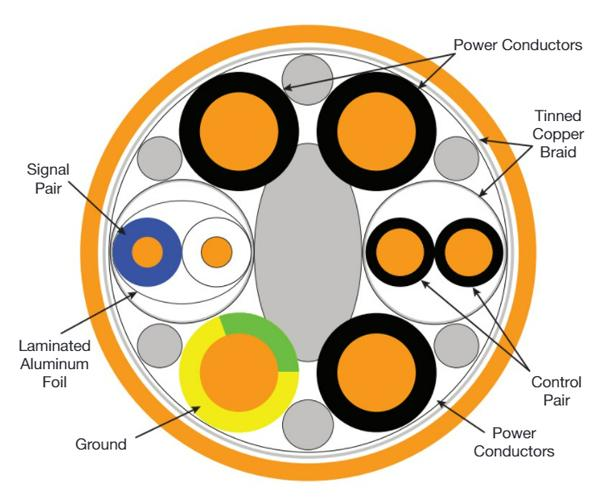
-
Braided shields
-
Foil shields
-
Combination shielding
However, more shielding is not automatically better.
The correct shielding design depends on the application, frequency range, installation method, grounding strategy, and EMC requirements.
For signal-sensitive applications such as encoder and servo systems, cable construction should be considered as part of the overall EMC design.
6. The Cheapest Cable May Have the Shortest Service Life
Let's look at a simplified example.
Suppose:
Cable A
Purchase price: $2/m
Expected service life: 1 year
Cable B
Purchase price: $4/m
Expected service life: 4 years
If a machine requires 100 meters of cable:
Cable A:
100 × $2 = $200
If replaced four times over four years:
Total cable purchase cost = $800
Cable B:
100 × $4 = $400
If it lasts four years:
Total cable purchase cost = $400
The more expensive cable actually costs 50% less over the same period — even before considering labor and downtime.
This is why purchasing decisions should focus on lifecycle cost, not simply the initial quotation.
7. How Should You Choose an Industrial Cable?
Instead of asking:
"What's the cheapest cable?"
A better question is:
"What's the most suitable cable for this application?"
Before selecting a cable, consider at least these factors.
① Is the cable static or dynamic?
Static applications and continuous-motion applications require different cable constructions.
② How often will it move?
A cable moving several times per minute has very different requirements from one that moves occasionally.
③ What is the bending radius?
A cable that is repeatedly bent below its recommended bending radius may experience premature failure.
④ What environment will it operate in?
Consider:
-
Oil
-
Water
-
Dust
-
Chemicals
-
Temperature
-
UV exposure
-
Mechanical abrasion
⑤ Does the cable need shielding?
For servo, encoder, communication, and other signal-sensitive applications, EMC performance may be critical.
⑥ What certification is required?
Depending on the target market and machine design, you may need cables meeting standards such as:
-
UL
-
CE-related requirements
-
RoHS
-
CPR
-
CSA
-
Other application-specific standards
The exact requirements depend on the machine, installation environment, and destination market.
Cheap Cable vs. Cost-Effective Cable
There is an important difference between these two concepts.
Cheap cable means low initial purchase price.
Cost-effective cable means achieving the required performance and service life at the lowest reasonable total cost.
They are not always the same thing.
For example, using a premium robotic cable in a completely static application may be unnecessary.
On the other hand, using a low-cost PVC cable inside a high-speed drag chain may create serious reliability problems.
The goal is not to buy the most expensive cable.
The goal is to buy the right cable for the application.
Cable Selection Should Start With the Machine
A good cable supplier should not only ask:
"What cable size do you need?"
They should also understand:
-
Where will the cable be installed?
-
Is it moving?
-
How fast does it move?
-
What is the travel distance?
-
What is the minimum bending radius?
-
What temperature will it experience?
-
Is there oil or chemical exposure?
-
Does it carry power or signals?
-
Is shielding required?
-
What certifications are needed?
These questions help determine whether you need a:
Drag Chain Cable
Servo Cable
Encoder Cable
Robot Cable
Control Cable
Reel Cable
or another specialized industrial cable.
The Bottom Line
A cable may represent only a small percentage of the total cost of a machine.
But its impact on machine reliability can be much larger than its price suggests.
A low-quality or unsuitable cable can lead to:
Premature failure → Maintenance → Downtime → Production Loss → Higher Total Cost
The right cable can help deliver:
Longer service life → Fewer failures → Less maintenance → Higher machine availability
So when comparing cable quotations, don't look only at the price per meter.
Look at the entire lifecycle of the machine.
Because the cheapest cable isn't necessarily the cheapest solution.
Sometimes, the cable that costs a little more today is the cable that saves you the most tomorrow.
Looking for reliable industrial cable solutions?
AEIN Cable has over 14 years of experience in manufacturing:
• UL CMP Plenum Cable
• Servo Cable
• Drag Chain Cable
• Robot Cable
• Continuous Flex Cable
Visit http://www.aein-wirecable.com to explore our products and technical resources.