


Good cables - Choose AEIN for international markets!
Location: Home > Information
hot keywords:
What Happens When Power and Signal Cables Are Routed Too Close Together?

What Happens When Power and Signal Cables Are Routed Too Close Together?-

Your machine is running. The motor starts. Suddenly, a sensor sends the wrong signal, an encoder reading jumps, or a PLC receives unexpected data. The first things you check are the sensor, the controller, and the software. But what if the problem starts somewhere much simpler—the way your cables are routed? In industrial automation, cable routing is often treated as a minor installation detail. Yet placing power cables and signal cables too close together can contribute to electrical interference, unstable signals, communication errors, and difficult-to-diagnose equipment problems. This does not mean that power and signal cables can never share a cable tray or pass through the same machine. The real issue is whether the installation creates an unacceptable level of electromagnetic interference (EMI) for the signals being transmitted. So, what actually happens when power and signal cables are routed too close together? And how can engineers reduce the risk? Let's look at the causes, warning signs, and practical solutions.

[ Details ]
Your Machine Keeps Stopping. Could the Cable Be the Real Problem?

Your Machine Keeps Stopping. Could the Cable Be the Real Problem?-

A practical troubleshooting guide for industrial automation engineers, machine builders, and maintenance teams. A machine stops unexpectedly. You reset the alarm, restart production, and everything seems fine — until the same problem happens again. You check the motor. You inspect the sensors. You review the control system. But the fault keeps returning. Have you considered the cable? Industrial cables are often overlooked because they appear to be simple connection components. In reality, they transmit power, control signals, and feedback data that keep automated equipment running. When a cable is damaged, incorrectly installed, or unsuitable for its working environment, it can contribute to intermittent faults, communication errors, and unexpected downtime. Of course, not every machine failure is caused by a cable. However, when a problem is intermittent or difficult to reproduce, cable inspection should be part of a systematic troubleshooting process. In this guide, we will explore six cable-related issues that may affect machine reliability, how to identify the warning signs, and what to consider when selecting a replacement.

[ Details ]
How to Choose the Right Drag Chain Cable

How to Choose the Right Drag Chain Cable-

A practical guide to cable construction, flexing cycles, shielding, jacket materials, speed, and application requirements A drag chain cable may look like an ordinary industrial cable. But once it is installed inside a cable carrier and starts moving thousands or even millions of times, the requirements change completely. A cable that works perfectly in a fixed installation may fail much earlier when exposed to continuous bending, torsion, acceleration, oil, abrasion, or repeated movement. That is why choosing a drag chain cable should not be based only on voltage, conductor size, or price. The real question is: Can the cable survive the specific motion and working environment of your machine? In this guide, we will walk through the most important factors to consider when selecting a drag chain cable, including cable construction, bending radius, flexing cycles, shielding, jacket materials, speed, temperature, and application requirements.

[ Details ]
Continuous Flex Cable: Everything You Need to Know

Continuous Flex Cable: Everything You Need to Know-

A cable can look perfectly normal on the outside and still fail after thousands—or millions—of movement cycles. In industrial automation, CNC machines, robotic systems, and automated production lines, cables are often exposed to continuous bending, flexing, twisting, and movement. A standard flexible cable may work well in a fixed installation, but it can fail much sooner when used in a continuously moving application. That is where continuous flex cable comes in. But what exactly makes a cable suitable for continuous motion? How is it different from an ordinary flexible cable? And how do you choose the right one for your machine? This guide explains the key things you need to know before selecting a continuous flex cable.

[ Details ]
How to Select Cable for Robotics Applications

How to Select Cable for Robotics Applications-

A robot can move thousands—or even millions—of times during its service life. But while the robot is working, its cables are moving too. They may bend continuously, twist around an axis, travel through a cable carrier, or move together with a robot arm. If the cable is not designed for these movements, it can become one of the first components to fail. And cable failure doesn't just mean replacing a cable. It can lead to machine downtime, production interruptions, unexpected maintenance costs, and even damage to other components. So, how do you choose the right cable for a robotic application? The answer depends on how the cable moves, where it is installed, and what the robot needs to do. In this guide, we'll walk through the most important factors to consider when selecting a robotics cable.

[ Details ]
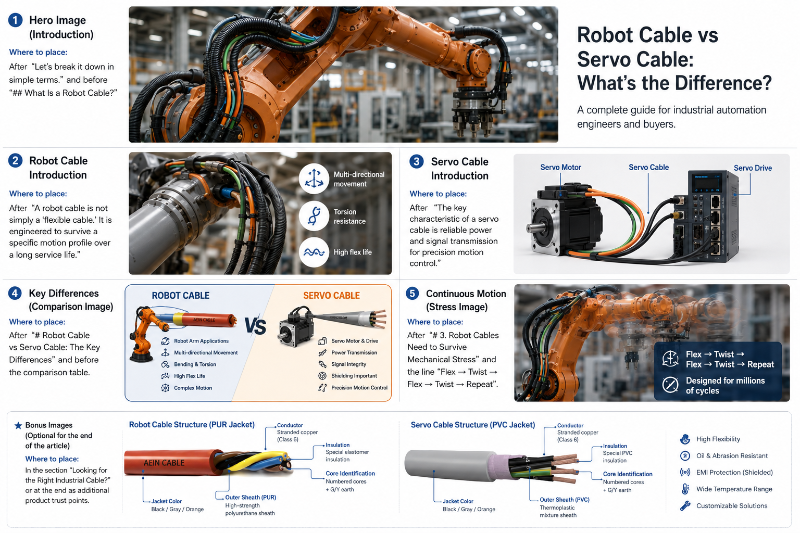
Robot Cable vs Servo Cable: What's the Difference?

Robot Cable vs Servo Cable: What's the Difference?-

Robot cable or servo cable — which one should you use for your automation system? At first glance, they may look very similar. Both are designed for industrial equipment, both can handle continuous movement, and both are commonly used in automated machinery. But they are not interchangeable in every application. Choosing the wrong cable can lead to signal interference, premature cable failure, unexpected downtime, and higher maintenance costs. So, what is the real difference between a robot cable and a servo cable? More importantly, which cable is right for your application? Let's break it down in simple terms.

[ Details ]
What Is a Drag Chain Cable? A Complete Guide for Industrial Automation Applications

What Is a Drag Chain Cable? A Complete Guide for Industrial Automation Applications-

In modern industrial automation, machines are required to move faster, work longer, and operate with higher precision than ever before. Behind every moving machine component, there is one small but critical part that is often overlooked — the cable. A standard cable may work well in fixed installations, but when a cable needs to move thousands or even millions of times inside a drag chain system, ordinary cables can quickly fail. This is where drag chain cables come into play. A drag chain cable is specially designed to withstand continuous bending, repeated movement, mechanical stress, and harsh industrial environments. But what exactly makes drag chain cables different from normal cables? And why are they essential for automation equipment? Let’s take a closer look.

[ Details ]
Top 7 Causes of Industrial Cable Failure and How to Prevent Costly Downtime

Top 7 Causes of Industrial Cable Failure and How to Prevent Costly Downtime-

In modern industrial automation, cables are often considered a simple connection component. However, in reality, industrial cables play a critical role in maintaining machine performance, signal stability, and production efficiency. A cable failure may stop an entire production line, damage expensive equipment, and create unexpected maintenance costs. For manufacturers using CNC machines, robots, automated production systems, and moving equipment, choosing the right industrial cable is not just about price — it is about long-term reliability. So, what causes industrial cables to fail? In this article, we will explore the top 7 causes of industrial cable failure and explain how to prevent these problems with proper cable selection and installation.

[ Details ]
Why Cheap Cable Can Become the Most Expensive Part of Your Machine

Why Cheap Cable Can Become the Most Expensive Part of Your Machine-

A cable may be one of the smallest components in an industrial machine. It is also one of the easiest components to underestimate. When purchasing industrial equipment, engineers and procurement teams often focus on motors, PLCs, drives, sensors, and mechanical components. Cable is sometimes treated as a simple consumable — something that just needs to transmit power or signals from Point A to Point B. But in an automated machine, a cable can do much more than that. It may need to bend millions of times, move continuously inside a drag chain, withstand oil and chemicals, resist electromagnetic interference, or maintain reliable signal transmission for years. This is why the cheapest cable is not always the most economical choice. In fact, a low-cost cable can become the most expensive part of your machine when it fails at the wrong time.

[ Details ]
Shielded vs Unshielded Servo Cable: Which One Should You Choose for Industrial Automation?

Shielded vs Unshielded Servo Cable: Which One Should You Choose for Industrial Automation?-

Choosing between shielded and unshielded servo cables is more than a technical decision. The wrong choice can lead to signal interference, unstable motion control, and unexpected downtime. Learn the key differences and find out which servo cable is rightfor your application.

[ Details ]
Prev 1 2 3 4 .... 11 Next