1. What Is a Drag Chain Cable?
A drag chain cable, also called a continuous-flex cable or dynamic cable, is designed for applications where the cable repeatedly moves inside a cable carrier or drag chain.
Typical applications include: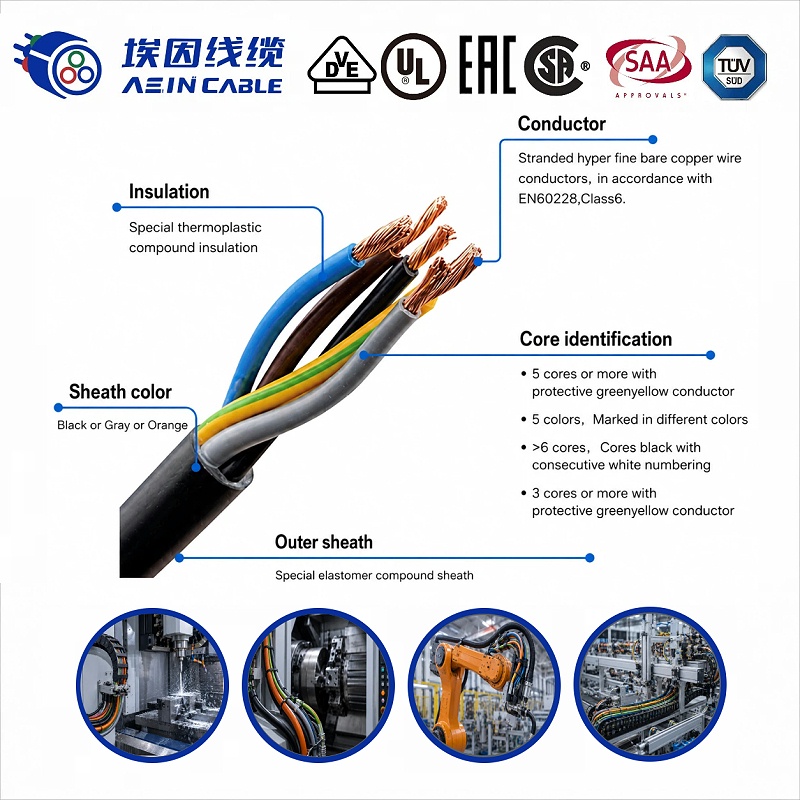
-
CNC machines
-
Machine tools
-
Automated production lines
-
Material handling systems
-
Packaging machinery
-
Pick-and-place equipment
-
Robotics
-
Semiconductor equipment
-
3D printers
-
Automated warehouse systems
Unlike fixed cables, drag chain cables must withstand repeated mechanical movement.
Depending on the application, the cable may experience:
-
Continuous bending
-
Repeated flexing
-
Tension
-
Compression
-
Twisting
-
Abrasion
-
High acceleration
-
Temperature changes
-
Exposure to oil or chemicals
This is why a flexible cable is not necessarily a drag chain cable.
A cable can be soft and flexible by hand but still fail quickly when subjected to continuous mechanical movement.
2. Why Is Cable Selection So Important?
Cable failure inside a drag chain can create problems far beyond simply replacing a cable.
A damaged cable may cause:
Machine downtime → production delays → maintenance costs → lost productivity
In automated equipment, the cable may also be difficult to replace because it is installed inside a moving cable carrier or routed through a complex machine structure.
For this reason, the lowest-cost cable is not always the lowest-cost solution.
A better approach is to consider the total operating requirements of the application.
3. 7 Key Factors When Choosing a Drag Chain Cable
3.1 Determine the Type of Motion
Start with the most important question:
How will the cable move?
Different machines create different mechanical stresses.
For example:
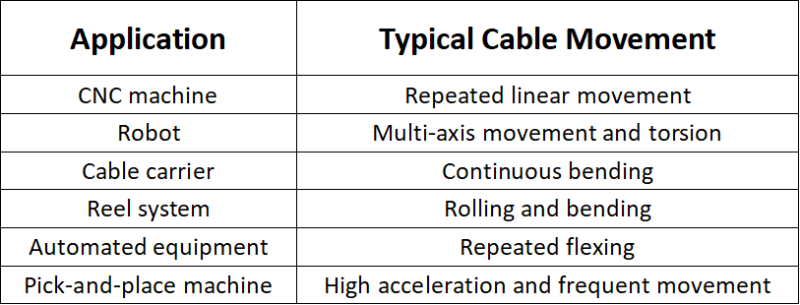
For a standard cable carrier, the cable mainly experiences repeated bending.
For robotic applications, however, the cable may experience bending, twisting, and torsion at the same time.
Therefore, a cable designed for ordinary drag-chain movement may not be suitable for a robotic arm.
3.2 Check the Bending Radius
The minimum bending radius is one of the most important specifications for a drag chain cable.
It indicates how tightly the cable can bend during operation.
For example, if a cable has a minimum dynamic bending radius of 7.5 × cable diameter, and the cable diameter is 10 mm:
10 mm × 7.5 = 75 mm
The dynamic bending radius should therefore be at least approximately 75 mm, according to that cable's specified requirement.
Never assume that a smaller bending radius is acceptable just because the cable can physically bend that far.
Repeatedly bending a cable below its specified radius can increase mechanical stress on:
-
Conductors
-
Insulation
-
Shielding
-
Fillers
-
Inner jackets
-
Outer sheath
Over time, this can lead to conductor breakage or insulation damage.
3.3 Consider the Required Flexing Cycles
How many times will the cable move during its service life?
This is another critical question.
A machine operating eight hours per day may generate thousands of movement cycles.
A highly automated production line may generate millions of cycles over its lifetime.
Therefore, ask the cable manufacturer:
What is the tested flexing performance of this cable under the specified conditions?
Don't rely only on phrases such as:
-
Flexible
-
High flexible
-
Extra flexible
-
Dynamic
-
Continuous flex
These descriptions can mean different things from one manufacturer to another.
More useful information includes:
-
Test conditions
-
Bending radius
-
Travel distance
-
Speed
-
Acceleration
-
Number of cycles
-
Temperature
-
Cable carrier configuration
The test conditions matter just as much as the claimed cycle count.
4. PVC vs. PUR: Which Jacket Material Should You Choose?
The outer jacket material has a major influence on cable performance.
Two common choices for industrial flexible cables are PVC and PUR.
PVC
PVC cables are widely used because they can offer: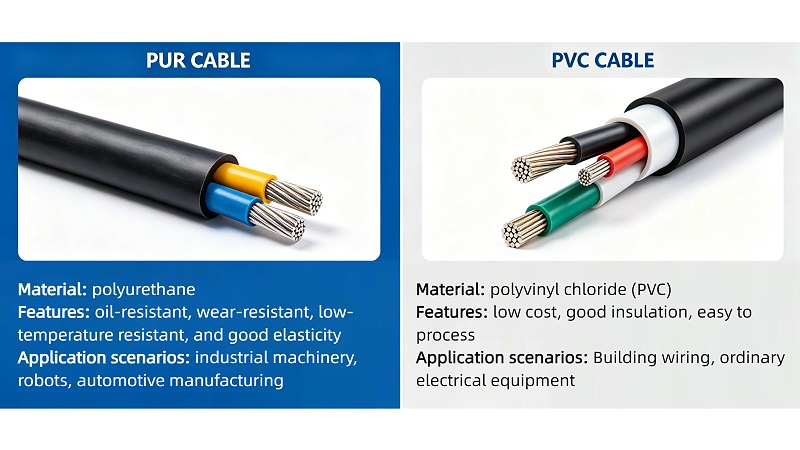
-
Good flexibility
-
Good electrical insulation
-
Cost-effectiveness
-
Good general-purpose performance
They can be suitable for many standard automation applications.
PUR
PUR is often selected when the cable needs greater resistance to:
-
Abrasion
-
Mechanical wear
-
Oil
-
Certain chemicals
-
Harsh industrial environments
For applications involving frequent movement and demanding mechanical conditions, PUR may be worth considering.
However, material selection should always be based on the actual operating environment and the manufacturer's specifications, rather than assuming one material is universally better.
5. Shielded or Unshielded?
The next question is whether the cable needs shielding.
This becomes particularly important when cables are used around equipment that can generate electromagnetic interference.
Examples include: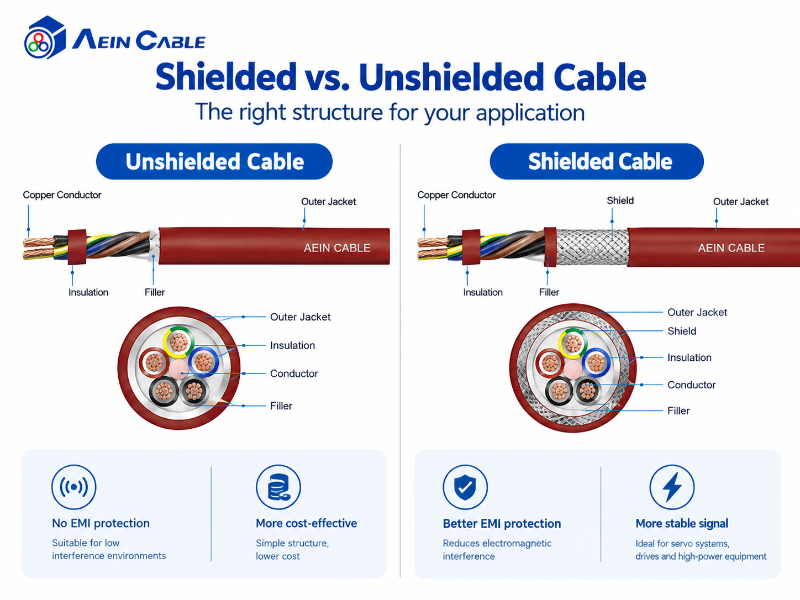
-
Servo motors
-
Variable-frequency drives
-
Inverters
-
Industrial controllers
-
High-power motors
-
Communication systems
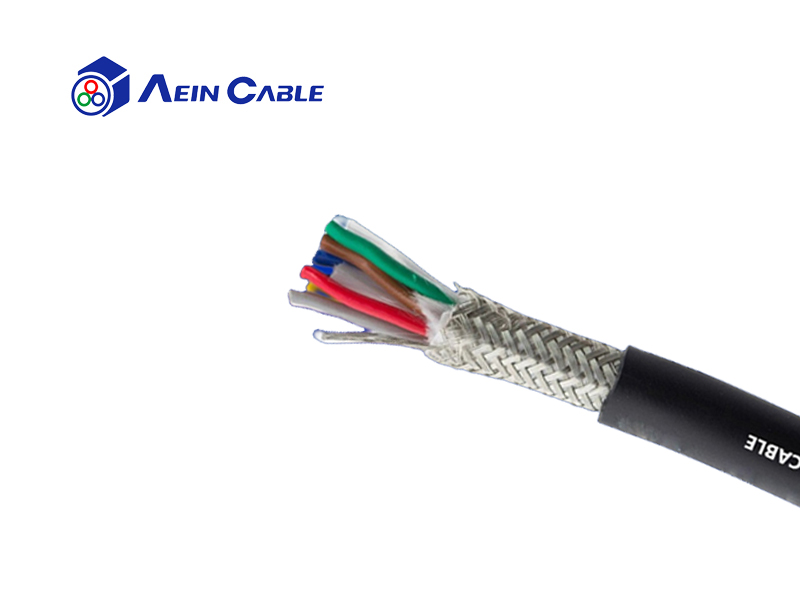
A shielded cable can help reduce electromagnetic interference when properly designed, installed, and grounded.
For example, a servo cable used between a servo drive and motor will often require shielding depending on the system design and EMC requirements.
However, not every drag chain cable needs shielding.
If the cable is used for a simple power supply or control circuit with low electromagnetic interference requirements, an unshielded design may be sufficient.
So instead of automatically choosing a shielded cable, ask:
Does the application actually require EMC protection?
6. Don't Forget the Cable's Internal Construction
Two cables with the same conductor size and outer diameter can have very different dynamic performance.
For continuous-flex applications, internal construction matters.
A properly designed drag chain cable may use:
-
Fine-stranded conductors
-
Special insulation materials
-
Optimized conductor stranding
-
Flexible fillers
-
Special shielding structures
-
Reinforced outer jackets
-
Balanced cable construction
Why are fine-stranded conductors important?
A solid conductor is excellent for many fixed installations, but repeated movement creates mechanical stress.
Fine-stranded conductors are generally better suited to repeated flexing because the individual strands can accommodate movement more effectively.
But conductor stranding is only one part of the design.
The complete cable structure needs to work together.
7. Check Speed and Acceleration
A common mistake is to look only at travel distance.
But the speed and acceleration of the cable can also affect its service life.
Consider two machines:
Machine A
-
Travel: 1 m
-
Speed: 0.5 m/s
-
Low acceleration
Machine B
-
Travel: 1 m
-
Speed: 3 m/s
-
High acceleration
Both have the same travel distance, but the mechanical stress on the cable can be very different.
For high-speed applications, ask the manufacturer about:
-
Maximum travel speed
-
Maximum acceleration
-
Recommended cable carrier configuration
-
Cable arrangement
-
Dynamic bending radius
These parameters should be evaluated together rather than individually.
8. Consider Temperature and Working Environment
A cable that performs well in a clean factory may not perform the same way in a harsh environment.
Before selecting a drag chain cable, identify the actual working conditions.
Temperature
Check:
-
Minimum operating temperature
-
Maximum operating temperature
-
Installation temperature
Oil
If the cable is used around:
-
CNC machines
-
Cutting fluids
-
Hydraulic systems
-
Lubricants
oil resistance may be important.
Chemicals
If the cable is exposed to cleaning agents, solvents, or other chemicals, check the sheath's chemical resistance.
Abrasion
If the cable frequently contacts other components, abrasion resistance becomes important.
Outdoor applications
For outdoor equipment, additional factors may include:
-
UV resistance
-
Weather resistance
-
Temperature changes
-
Moisture resistance
9. Common Mistakes When Selecting Drag Chain Cables
Mistake 1: Choosing a Standard Flexible Cable
"Flexible" doesn't automatically mean "continuous-flex."
A cable designed for occasional movement may fail much sooner when installed in a drag chain.
Mistake 2: Looking Only at Price
The initial cable price is only one part of the total cost.
Consider:
Cable price + installation + maintenance + downtime + replacement cost
A cable that costs slightly more but lasts significantly longer may reduce the total operating cost.
Mistake 3: Ignoring the Bending Radius
Even a high-quality cable can fail prematurely if it is forced to bend below its specified radius.
Always check the dynamic bending radius, not just the static bending radius.
Mistake 4: Overlooking Cable Arrangement
Cables inside a drag chain should not simply be packed together.
Depending on the cable carrier and application, improper arrangement can lead to:
-
Excessive friction
-
Cable compression
-
Twisting
-
Uneven movement
-
Premature wear
The cable installation itself can therefore affect service life.
Mistake 5: Selecting the Cable Without Considering the Machine
The cable should be selected after understanding the machine movement, not before.
Ask these questions first:
-
How far does the cable travel?
-
How fast does it move?
-
How often does it move?
-
What is the bending radius?
-
Is there torsion?
-
What temperature does it experience?
-
Is oil present?
-
Is shielding required?
Only then should you choose the cable construction.
10. Drag Chain Cable Selection Checklist
Before placing an order, you can use this simple checklist:
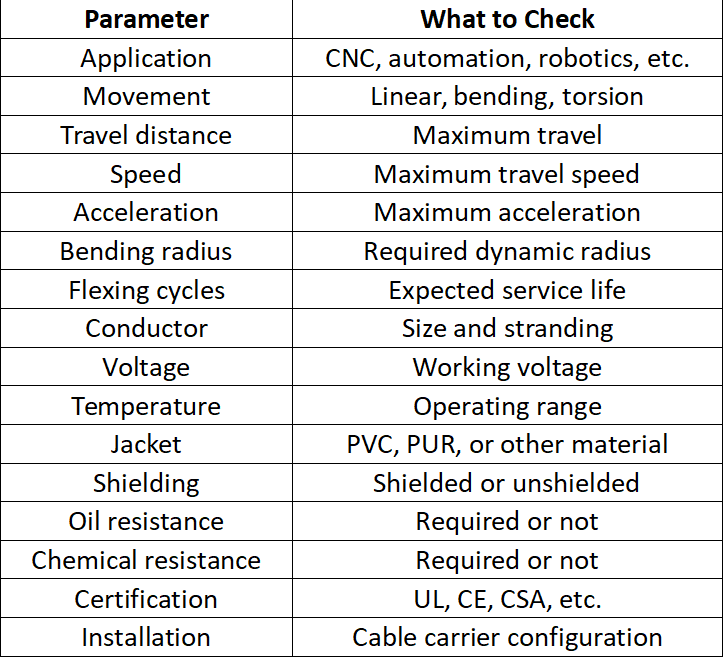
If you can provide these parameters to the cable manufacturer, the manufacturer can usually recommend a much more suitable cable than simply saying:
"I need a flexible cable."
11. What About Certification?
Certification can also be important, especially when the machine will be exported.
Depending on the target market and application, you may need cables that comply with specific standards or certifications.
Common requirements may include:
-
UL
-
CSA
-
CE-related requirements
-
RoHS
-
EN standards
-
IEC standards
But certification should not replace technical selection.
A certified cable can still be unsuitable if its mechanical design does not match the application's movement.
Certification tells you about compliance with certain requirements. It does not automatically mean the cable is suitable for every drag chain application.
12. A Simple Example
Imagine you're selecting a cable for a CNC machine.
The machine has:
-
10 m continuous travel
-
2 m/s travel speed
-
Frequent daily operation
-
Cable carrier installation
-
Cutting oil exposure
-
Limited installation space
-
Strong electromagnetic interference from servo drives
Instead of simply searching for:
"flexible cable"
you should define the requirements more precisely:
Continuous-flex cable + suitable dynamic bending radius + high flexing performance + oil resistance + appropriate shielding + suitable voltage/current rating + compatible outer diameter.
This approach gives the cable manufacturer much more useful information.
And more importantly, it gives you a better chance of selecting a cable that will actually survive the machine's operating conditions.
Looking for reliable industrial cable solutions?
AEIN Cable has over 14 years of experience in manufacturing:
• UL CMP Plenum Cable
• Servo Cable
• Drag Chain Cable
• Robot Cable
• Continuous Flex Cable
Visit http://www.aein-wirecable.com to explore our products and technical resources.