Table of Contents
-
How Can a Cable Cause Machine Downtime?
-
Six Cable-Related Problems to Check
-
How to Troubleshoot Cable Problems Step by Step
-
How to Choose the Right Industrial Cable
-
When Should You Replace an Industrial Cable?
-
Final Checklist for More Reliable Machine Operation
1. How Can a Cable Cause Machine Downtime?
Modern industrial machines rely on several types of cables, each with a different job.
-
Power cables supply electrical energy to motors and other equipment.
-
Servo cables connect servo drives and motors, depending on the system design.
-
Encoder and feedback cables transmit position, speed, or other feedback signals.
-
Control cables carry control signals between electrical components.
-
Drag chain cables are designed for applications involving repeated movement in cable carriers.
-
Industrial communication cables transmit data between controllers, sensors, drives, and other devices.
If one of these cables develops a fault, the result may be more complicated than a complete loss of power.
A damaged conductor may cause intermittent operation. Poor shielding or grounding may contribute to signal interference. A cable designed for fixed installation may wear out prematurely when repeatedly bent.
The challenge is that some cable problems only appear under specific conditions, such as machine movement, temperature changes, vibration, or high electrical loads.
That is why replacing components at random is rarely the best troubleshooting strategy.
2. Six Cable-Related Problems to Check
Problem 1: Broken Conductors Inside the Cable
A cable can look perfectly normal on the outside while one or more conductors inside are damaged.
Repeated bending, excessive pulling force, improper installation, or unsuitable cable construction may contribute to conductor fatigue. In moving applications, damage can develop gradually until the electrical connection becomes intermittent or fails
completely.
Common warning signs include:
-
Faults that appear only when a machine axis moves.
-
Intermittent power or signal transmission.
-
Unexpected sensor or encoder errors.
-
Electrical continuity that changes as the cable moves.
What to check:
Inspect the cable route for tight bends, tension, crushing, or repeated contact with sharp edges. If a conductor fault is suspected, isolate the equipment safely and follow the manufacturer's diagnostic procedures.
Do not bend or manipulate an energized cable to reproduce a fault.
Problem 2: Electromagnetic Interference in Signal Cables
Industrial environments contain potential sources of electromagnetic interference, including variable frequency drives, servo drives, motors, contactors, and switching equipment.
If sensitive signal cables are routed incorrectly or the shielding and grounding arrangements are unsuitable, electrical noise may affect signal transmission.
Possible symptoms include unstable feedback, communication errors, unexpected alarms, or inconsistent sensor readings.
What to check:
-
Whether power and sensitive signal cables are routed appropriately.
-
Whether the cable shielding matches the application's requirements.
-
Whether shield termination and grounding follow the equipment manufacturer's recommendations.
-
Whether connectors and cable entries are secure and correctly installed.
A shielded cable can help reduce electromagnetic interference, but shielding alone does not guarantee a noise-free system. Cable construction, installation, grounding, and equipment compatibility all matter.
Problem 3: The Cable Is Not Designed for Repeated Movement
One of the most common selection mistakes is assuming that any flexible cable can be used in a moving application.
A cable may be flexible enough for installation but not designed to withstand thousands or millions of repeated movement cycles.
For example, a standard cable intended for fixed installation may not perform reliably inside a continuously moving drag chain.
Warning signs include:
-
Cracks or deformation in the outer sheath.
-
Repeated conductor failures in the same section.
-
Cable twisting or tangling inside a cable carrier.
-
Visible wear where the cable contacts other components.
What to check:
Determine whether the cable is suitable for the actual movement pattern. Consider the bending radius, travel distance, acceleration, movement frequency, cable arrangement, and expected service life.
For applications involving repeated linear movement, a properly specified drag chain cable may be a more suitable choice.
For robotic applications involving complex multidirectional movement, torsional performance may also be important.
Problem 4: The Cable Jacket Is Unsuitable for the Environment
The outer jacket protects the cable from environmental and mechanical stresses. If its material is not compatible with the application, the cable may deteriorate prematurely.
Different environments create different challenges:
-
Oil and coolant: Some jacket materials may swell, soften, or deteriorate after prolonged exposure.
-
Low temperatures: Certain materials may become less flexible and more vulnerable to cracking.
-
Abrasion: Repeated contact with machine components may wear through the jacket.
-
Outdoor exposure: UV radiation, moisture, and temperature fluctuations may affect material performance.
-
Chemical exposure: Compatibility depends on the specific chemical, concentration, temperature, and exposure duration.
PVC, PUR, and TPE are examples of materials used in different industrial cable designs. None is automatically the best choice for every application.
What to check:
Identify the actual environmental conditions and consult the cable manufacturer's material compatibility data. Do not select a jacket based on a general material name alone.
Problem 5: Incorrect Cable Installation
Even a well-designed cable can fail early if it is installed incorrectly.
Common installation issues include:
-
Exceeding the recommended minimum bending radius.
-
Applying excessive pulling force during installation.
-
Leaving the cable under constant tension.
-
Incorrectly arranging cables inside a drag chain.
-
Allowing cables to rub against sharp edges or moving parts.
-
Using unsuitable clamps, connectors, or strain relief.
In cable carriers, cables must have sufficient space to move freely. Incorrect filling, overlapping, or poor separation can create additional mechanical stress.
What to check:
Compare the actual installation with the cable and cable-carrier manufacturer's guidelines. Check the full movement path rather than inspecting only the visible section near the machine.
Correcting the installation may be just as important as replacing the cable.
Problem 6: The Cable Is Incorrectly Specified for the Application
Sometimes the cable is not defective. It simply does not meet the requirements of the equipment.
For example, a cable may have the correct number of conductors but an unsuitable voltage rating, conductor cross-section, temperature range, shielding arrangement, or movement capability.
Other important factors include signal requirements, connector compatibility, applicable standards, and exposure to environmental stresses.
A cable selected only by its outside diameter or price may overlook requirements that are critical to long-term performance.
What to check:
Compare the cable specifications with the machine manufacturer's requirements. If the cable is part of a servo, encoder, robotic, or other specialized system, confirm that its electrical and mechanical characteristics are appropriate for that specific
application.
3. How to Troubleshoot Cable Problems Step by Step
When a machine experiences recurring faults, a structured diagnostic process can help reduce unnecessary component replacement.
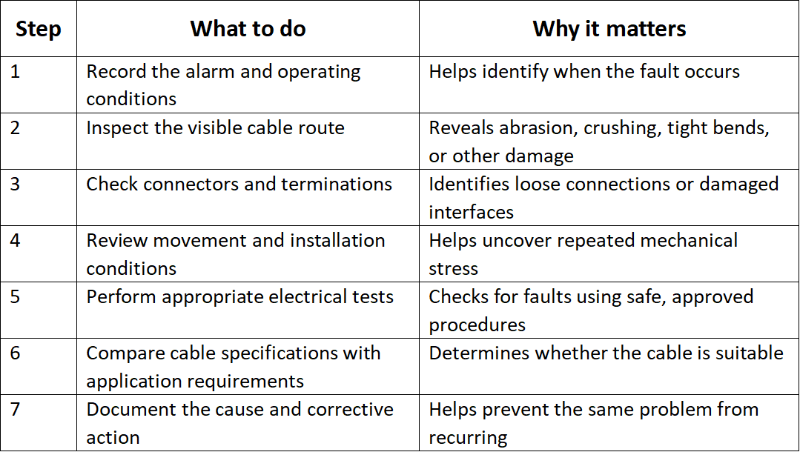
Always follow the equipment manufacturer's safety procedures and isolate power before inspection or testing where required. Electrical testing should be performed by qualified personnel using suitable instruments and methods.
For servo systems, communication networks, and other sensitive equipment, follow the relevant manufacturer's diagnostic instructions. An inappropriate test method may damage connected electronics.
Most importantly, distinguish between the symptom and the root cause.
Replacing a cable without correcting excessive bending, poor routing, or an unsuitable application specification may simply lead to another failure.
4. How to Choose the Right Industrial Cable
If cable problems occur repeatedly, reviewing the original cable selection is worthwhile.
Before choosing a replacement, answer these five questions.
1. What Does the Cable Need to Transmit?
Determine whether the cable carries power, control signals, encoder feedback, or communication data.
Different functions require different electrical characteristics and constructions.
2. Will the Cable Move?
Identify whether the application involves fixed installation, repeated bending, continuous travel, or torsional movement.
A cable designed for one movement pattern should not automatically be assumed suitable for another.
3. What Environmental Conditions Will It Face?
Consider temperature, oil, coolant, abrasion, moisture, chemicals, and outdoor exposure.
Select the jacket and construction based on the actual environment and verified material compatibility.
4. What Electrical and Mechanical Specifications Are Required?
Check the conductor cross-section, voltage rating, shielding, capacitance where relevant, bending radius, travel conditions, and connector requirements.
For high-speed or high-flex applications, verify the manufacturer's test conditions and performance data instead of relying on general descriptions such as "high flexible."
5. What Standards and Documentation Are Required?
Depending on the market and application, you may need specific approvals, declarations, test reports, or material compliance documentation.
Always verify that the documentation applies to the exact cable model and intended use. A general company certificate does not necessarily establish that every product has the same approval.
A suitable industrial cable is not necessarily the most expensive option. It is the cable whose verified performance matches the application requirements.
5. When Should You Replace an Industrial Cable?
Not every cable needs immediate replacement when a machine experiences an alarm. However, certain conditions require prompt attention.
Consider replacing the cable when:
-
Conductors are confirmed to be damaged.
-
Insulation or the outer jacket is cracked, cut, or severely deformed.
-
Electrical tests identify a fault.
-
Connectors or terminations are damaged beyond acceptable repair.
-
The cable does not meet the equipment's required specifications.
-
The cable repeatedly fails despite appropriate installation and maintenance.
Follow the equipment manufacturer's instructions and applicable safety requirements when deciding whether a cable can be repaired or must be replaced.
It is also useful to record the replacement date, operating conditions, failure location, and suspected cause. Over time, this information can help identify recurring problems and improve maintenance planning.
For critical equipment, preventive replacement intervals should be based on risk, operating conditions, inspection results, and reliable service data rather than an arbitrary schedule.
6. Final Checklist for More Reliable Machine Operation
Before returning a machine to service, use this checklist to review potential cable-related problems.
-
Check for visible cable damage, abrasion, crushing, or deformation.
-
Inspect connectors, terminations, and strain relief.
-
Confirm that cable routing and bending radius meet the manufacturer's requirements.
-
Verify that moving cables are suitable for the actual movement pattern.
-
Review shielding, grounding, and separation between power and sensitive signal cables.
-
Confirm that the jacket material is compatible with the operating environment.
-
Check that the cable's electrical and mechanical specifications match the application.
-
Record the fault and verify that the corrective action addresses its likely root cause.
Not every unexpected machine stop is a cable problem. But systematically checking the cable can help identify an overlooked cause before unnecessary replacements and repeated downtime add up.
Looking for reliable industrial cable solutions?
AEIN Cable has over 14 years of experience in manufacturing:
• UL CMP Plenum Cable
• Servo Cable
• Drag Chain Cable
• Robot Cable
• Continuous Flex Cable
Visit http://www.aein-wirecable.com to explore our products and technical resources.