1. Start With the Robot's Movement
The first question is simple:
How will the cable move?
Different robotic applications create very different mechanical stresses.
For example:
-
A cable installed inside a robot arm may experience continuous bending and torsion.
-
A cable inside a cable carrier may repeatedly bend in one direction.
-
A cable on an automated production line may move back and forth thousands of times per day.
-
A welding robot may expose the cable to sparks, heat, oil, and mechanical stress.
These applications should not necessarily use the same type of cable.
Common robotic cable movements include:
Continuous bending
The cable repeatedly bends during machine operation.
This is common in cable carriers, linear axes, CNC machines, and moving robotic equipment.
Torsional movement
The cable twists around its own axis.
This is particularly important for robotic arms and articulated robots.
Combined bending and twisting
Some robotic applications create both movements at the same time.
This is one of the most demanding conditions for cable construction.
Fixed installation
If the cable does not move after installation, a standard fixed cable may be sufficient.
The key point is:
Don't select a cable based only on the electrical specification. Select it based on the mechanical movement as well.
2. Understand the Difference Between Robot Cable and Other Flexible Cables
The term "robot cable" covers many different cable designs.
A cable used for a robot arm is not necessarily the same as a cable designed for a drag chain.
For example, drag chain cables are primarily designed for repeated bending along a defined bending radius.
Robotic cables, especially those used in articulated arms, may need to withstand repeated torsion and multi-axis movement.
Servo cables are commonly used to connect servo motors and drives, where electrical performance, shielding, and electromagnetic compatibility are important.
So before selecting a cable, determine whether your application requires:
-
Continuous flexing
-
Torsional resistance
-
High-speed movement
-
Multi-axis movement
-
Drag-chain installation
-
Servo motor connection
-
Encoder feedback
-
Power transmission
-
Signal transmission
This prevents a common mistake: choosing a cable because it is labeled "flexible" without checking whether it is actually designed for the required movement.
3. Check the Minimum Bending Radius
The bending radius is one of the most important specifications for a flexible cable.
It describes how tightly a cable can bend without exceeding the manufacturer's recommended mechanical limits.
A cable installed in a small robot arm may require a much smaller bending radius than a cable installed in a large cable carrier.
If the cable is forced to bend too tightly, several problems can occur:
-
Conductor fatigue
-
Insulation damage
-
Shield deformation
-
Jacket cracking
-
Reduced service life
-
Electrical failure
Therefore, always compare the cable's minimum bending radius with the actual installation conditions.
A useful rule is:
The smaller the available installation space, the more important the cable's bending performance becomes.
However, don't assume that a smaller bending radius is always better. The actual bending radius should be selected according to the cable design and application requirements.
4. Consider the Number of Flexing Cycles
A robot cable may move continuously throughout the working day.
Imagine a cable that moves back and forth once every few seconds.
Over several months, the number of movement cycles can become extremely high.
This is why a cable's flexing capability matters.
When comparing cables, ask the manufacturer:
-
What type of movement is the cable designed for?
-
Is it suitable for continuous flexing?
-
Is it suitable for torsional movement?
-
What test method was used?
-
What is the expected flexing or torsion performance?
-
What bending radius was used during testing?
Don't rely only on phrases such as "high flexible" or "robot cable."
For demanding applications, the actual mechanical specifications and test conditions are much more important than the marketing name.
5. Choose the Right Conductor Construction
The conductor plays a major role in cable flexibility.
For continuously moving applications, manufacturers typically use finely stranded or specially constructed conductors instead of simple rigid conductors.
The conductor construction can affect:
-
Flexibility
-
Fatigue resistance
-
Electrical performance
-
Service life
-
Overall cable diameter
For robotic applications, the conductor should be selected according to both the required current and the expected mechanical movement.
For example, a cable that works perfectly in a fixed installation may not be suitable for millions of bending cycles.
6. Select the Right Insulation and Jacket Material
The outer jacket is the cable's first line of protection against the surrounding environment.
Different robotic applications may require different jacket materials.
PVC
PVC cables can be a practical choice for many general industrial applications.
They can offer good electrical insulation, mechanical protection, and cost efficiency.
PUR
PUR is often selected for demanding moving applications because of its combination of flexibility and resistance to mechanical wear.
Depending on the formulation, PUR jackets can also provide good resistance to:
-
Oil
-
Abrasion
-
Chemicals
-
Mechanical stress
This makes PUR a common option for demanding automation and robotic environments.
TPE and other materials
Other thermoplastic materials may also be used when specific requirements such as flexibility, temperature resistance, or environmental performance need to be balanced.
The best material depends on the application—not simply on which material sounds more advanced.
7. Don't Ignore Oil, Chemicals, and Abrasion
Industrial robots rarely operate in a perfectly clean environment.
A cable may come into contact with:
-
Hydraulic oil
-
Cutting fluids
-
Lubricants
-
Cleaning chemicals
-
Metal particles
-
Dust
-
Welding residues
If the cable jacket is not compatible with the environment, it can become brittle, swollen, cracked, or mechanically damaged over time.
For machine tools and industrial automation, oil resistance and abrasion resistance can be just as important as flexibility.
For welding applications, additional protection against welding sparks and spatter may also be required.
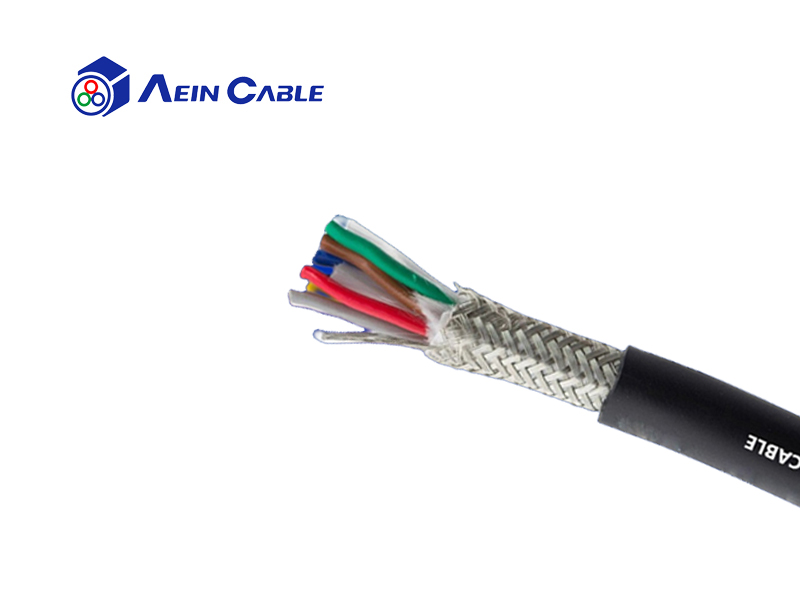
8. Decide Whether You Need Shielding
Electrical noise can be a serious problem in robotic systems.
Motors, variable-frequency drives, servo drives, switching devices, and power cables can generate electromagnetic interference.
If a cable is carrying sensitive signals, encoder feedback, or communication signals, shielding may be necessary.
A shielded cable can help reduce electromagnetic interference when properly designed and installed.
For example, shielding is often considered for:
-
Servo systems
-
Encoder cables
-
Feedback cables
-
Communication cables
-
Sensitive control signals
But shielding should not be added automatically.
The cable design should consider the complete system, including grounding, installation, connectors, and the surrounding electrical environment.
9. Check the Temperature Range
Robotic equipment can operate in environments with significant temperature variations.
Before selecting a cable, check:
-
Minimum operating temperature
-
Maximum operating temperature
-
Ambient temperature
-
Temperature generated by nearby equipment
-
Temperature during continuous movement
Temperature affects both the mechanical and electrical performance of a cable.
A jacket that performs well at room temperature may behave differently in a very cold or hot environment.
For outdoor robots, automated warehouses, machine tools, and other demanding applications, temperature should be included in the cable selection process from the beginning.
10. Consider Voltage, Current, and Electrical Requirements
Mechanical performance is only half of the equation.
The cable must also meet the electrical requirements of the robot.
Check:
-
Rated voltage
-
Conductor size
-
Current capacity
-
Insulation material
-
Number of cores
-
Capacitance, where relevant
-
Shielding requirements
-
Signal integrity requirements
For power applications, conductor size and voltage rating are critical.
For signal and feedback applications, electrical noise, capacitance, impedance, and shielding can become more important.
This is why there is no single "best robot cable."
The right cable depends on the job it needs to perform.
11. Check Certifications and Market Requirements
If the robotic equipment will be exported, cable certification can become an important purchasing requirement.
Depending on the target market and application, you may need to consider standards or certifications such as:
-
UL
-
CSA
-
CE-related requirements
-
RoHS
-
Other application-specific standards
For example, a cable selected for equipment exported to North America may have different certification requirements from one intended for another market.
Before ordering, confirm both:
Does the cable meet the electrical and mechanical requirements?
and
Does it meet the certification requirements of the target market?
This can prevent expensive replacement or compliance problems later.
A Simple Checklist for Choosing Robot Cable
When evaluating a cable for a robotic application, start with these questions:
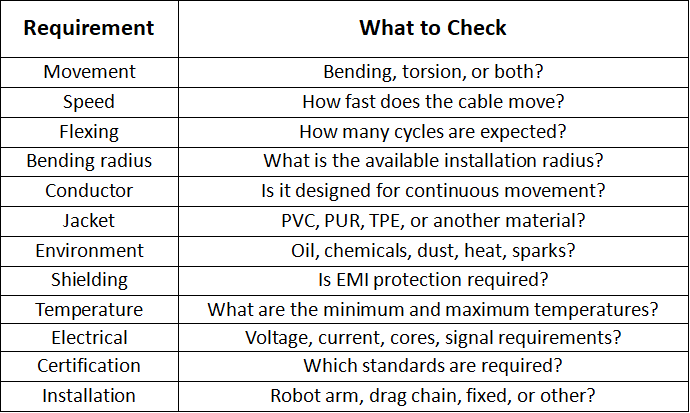
If you can answer these questions, you are already much closer to selecting the right cable.
Common Mistakes When Selecting Robot Cable
Mistake 1: Choosing based only on price
A cheaper cable may look attractive during purchasing.
But if it fails after a short period of continuous movement, the real cost can include:
Cable replacement + machine downtime + labor + lost production.
The initial cable price is only one part of the total cost.
Mistake 2: Using a standard flexible cable for a robotic arm
"Flexible" does not automatically mean "suitable for robotic torsion."
A cable designed for simple bending may not survive repeated multi-axis movement.
Mistake 3: Ignoring the bending radius
Even a high-quality flexible cable can have a shortened service life if it is installed below its recommended bending radius.
Mistake 4: Selecting the wrong jacket material
A cable may perform well mechanically but fail prematurely because of oil, chemicals, abrasion, or temperature.
Mistake 5: Looking only at the cable itself
The cable, connector, cable routing, robot movement, and installation method all affect cable life.
A good cable installed incorrectly can still fail.
How AEIN Can Help With Robotic Cable Selection
Choosing the right cable can be difficult when the application has several requirements at the same time.
At AEIN, we focus on industrial cables for automation and demanding moving applications.
Our product range includes: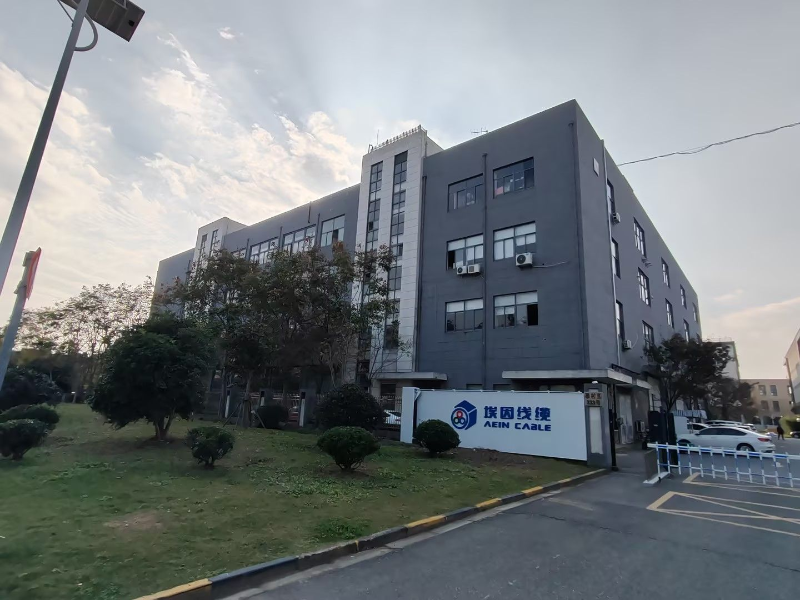
-
Robot cables
-
Drag chain cables
-
Servo cables
-
Encoder cables
-
Control cables
-
Reel cables
-
Industrial flexible cables
Depending on the application, cable designs can be selected based on requirements such as continuous flexing, torsional movement, shielding, oil resistance, flame performance, temperature range, and international certification requirements.
Instead of simply asking:
"Which cable do you sell?"
it is often better to ask:
"Which cable is suitable for my robot's movement and working environment?"
If you can provide information about the robot type, movement, cable length, bending radius, voltage, current, environment, and required certifications, a cable manufacturer can help you narrow down the right solution.
Final Thoughts
Selecting a cable for a robotic application is not simply about choosing a cable with the right number of cores and voltage rating.
You need to consider mechanical movement, bending radius, flexing cycles, torsion, jacket material, environmental conditions, shielding, electrical performance, and certification requirements together.
The right cable should match the way the robot actually works.
Because in automation, a cable may look like a small component—but when it fails, the entire machine can stop.
Choose the cable for the movement, not just the machine.
If you're selecting a cable for a robotic arm, cable carrier, servo system, or other moving automation equipment, reviewing the application requirements with a cable manufacturer before ordering can help avoid costly mistakes.
Learn more about AEIN's industrial cable solutions or contact our team to discuss your application and cable requirements.