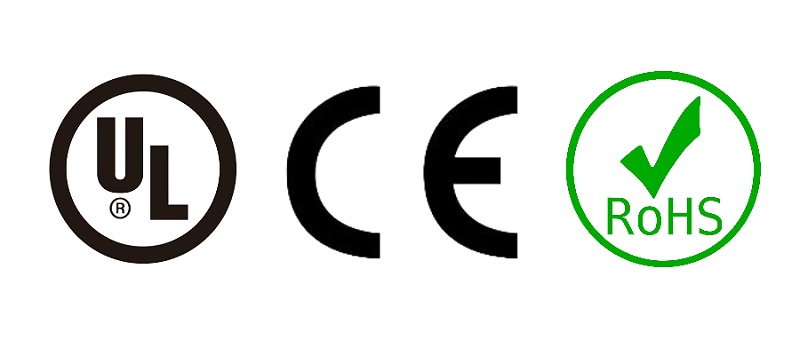
1. UL: Has the Cable Been Evaluated for Safety?
UL is one of the most recognized names in electrical product safety certification, particularly in the North American market.
UL stands for Underwriters Laboratories, now operating as UL Solutions. Its certification programs evaluate products against applicable safety requirements and standards.
For cables, UL certification may involve evaluating several important characteristics, depending on the cable type and applicable standard:
-
Electrical insulation performance
-
Resistance to heat
-
Flame-related performance
-
Construction and material requirements
-
Suitability for specific applications
For example, UL 758 is a widely used standard for Appliance Wiring Material (AWM), while other cable categories have their own applicable standards.
However, an important point is often overlooked: Not all UL marks mean the same thing.
UL Listed vs. UL Recognized
These two terms are particularly important when selecting industrial cables.
UL Listed
A UL Listed product has been evaluated against applicable safety requirements for its intended use. It is generally intended for installation or use as a complete product within the scope of its listing.
UL Recognized
A UL Recognized Component is evaluated for use as part of a larger product or system, subject to specified conditions of acceptability.
For example, a cable carrying a UL AWM designation may be intended for internal wiring in equipment rather than unrestricted field installation.
This distinction matters when selecting cables for machinery, control panels, and industrial equipment.
A cable suitable for internal equipment wiring is not automatically suitable for every external installation.
What should buyers check?
Don't simply look for the letters "UL" printed on a cable.
Check the actual certification scope, cable type, applicable standard, ratings, and certification records. For UL wire and cable products, the complete certification mark on the reel, tag, or packaging is particularly important.
2. CE: Does the Product Meet Applicable EU Requirements?
CE marking is another label frequently encountered in international cable procurement.
CE stands for Conformité Européenne. It indicates that a product conforms to the applicable EU legislation requiring CE marking.
Unlike UL certification, CE marking is not a general quality award or a universal third-party safety certificate.
It is a regulatory conformity marking.
Depending on the product and its intended application, relevant EU legislation may include:
-
Low Voltage Directive (LVD)
-
Electromagnetic Compatibility Directive (EMC), where applicable
-
RoHS Directive, where applicable
-
Other relevant EU legislation
For electrical products falling within the scope of the Low Voltage Directive, manufacturers must demonstrate compliance with the applicable safety requirements, prepare the required technical documentation, and draw up an EU Declaration of Conformity
before affixing the CE marking.
Does Every Industrial Cable Need Its Own CE Mark?
Not necessarily.
This is an important detail for cable buyers.
Some cables are supplied as components of larger electrical equipment. In these cases, the cable may be covered by the conformity assessment and documentation of the finished equipment.
Other cables placed on the EU market independently may have their own applicable conformity and documentation requirements.
The exact requirements depend on the cable's design, intended use, and applicable legislation.
Therefore, when a supplier claims that a cable is CE compliant, ask a more specific question:
Which EU directive or regulation does this cable comply with, and can you provide the relevant Declaration of Conformity?
A CE logo alone does not explain the scope of conformity.
3. RoHS: Does the Cable Meet Restricted Substance Requirements?
RoHS stands for Restriction of Hazardous Substances.
It is an EU directive designed to restrict the use of certain hazardous substances in electrical and electronic equipment.
The current RoHS framework restricts ten substances, including:
-
Lead (Pb)
-
Mercury (Hg)
-
Cadmium (Cd)
-
Hexavalent Chromium (Cr VI)
-
Polybrominated Biphenyls (PBB)
-
Polybrominated Diphenyl Ethers (PBDE)
-
Four phthalates: DEHP, BBP, DBP, and DIBP
Why does this matter for industrial cables?
Cable insulation and sheathing materials may contain different chemical additives to achieve specific properties, such as flexibility, flame retardancy, oil resistance, or durability.
RoHS compliance helps ensure that restricted substances do not exceed the applicable concentration limits in homogeneous materials, subject to the directive's exemptions and conditions.
For industrial buyers, this is particularly relevant when sourcing cables for:
-
Electronic and electrical equipment
-
Industrial automation systems
-
Control cabinets
-
Machinery and equipment exports
-
Projects requiring environmental compliance documentation
Does RoHS Mean a Cable Is Completely Non-Toxic?
No.
RoHS compliance does not mean that a cable contains absolutely no hazardous substances.
It means that the substances restricted under the applicable RoHS requirements are within the permitted limits or covered by relevant exemptions.
It also does not automatically mean that the cable is halogen-free, low-smoke, or environmentally harmless in every respect.
These are separate material and performance characteristics that require their own specifications and, where necessary, testing.
4. UL vs. CE vs. RoHS: What Is the Difference?
Now that we understand each label, let's compare them side by side.
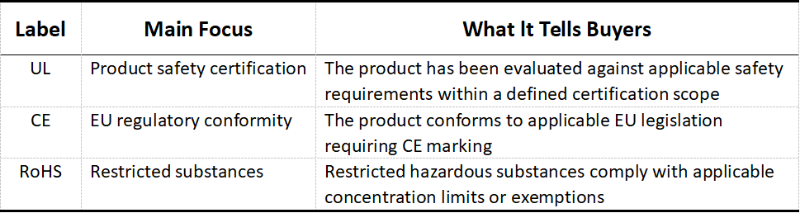
The most important takeaway is simple:
These three labels are not interchangeable.
A cable with RoHS compliance is not automatically UL Listed.
A UL-certified cable is not automatically CE compliant.
And a CE marking does not automatically prove that a cable meets every technical requirement of your application.
Each mark addresses a different aspect of product compliance.
5. What Should You Check Before Buying a Certified Cable?
For industrial cable buyers, certification marks should be the starting point of your evaluation, not the final decision.
Here are five practical checks worth making before placing an order.
1. Confirm the Exact Cable Type
Different cables have different construction requirements and certification scopes.
For example, power cables, servo cables, drag chain cables, control cables, and robot cables may need to meet different technical standards.
Make sure the certification applies to the exact cable model you intend to purchase.
2. Check the Rated Voltage and Temperature
A certification mark alone does not tell you whether the cable is suitable for your operating conditions.
Always check:
-
Rated voltage
-
Temperature range
-
Conductor size and material
-
Insulation and sheath materials
-
Applicable installation conditions
A cable with the right certification but the wrong voltage or temperature rating can still be an unsuitable choice.
3. Request Supporting Documents
A professional cable supplier should be able to provide relevant documentation, such as:
-
UL certification or listing information, where applicable
-
EU Declaration of Conformity, where required
-
RoHS test reports or declarations
-
Technical datasheets
-
Product construction specifications
Make sure the model numbers and product descriptions in these documents match the cable being supplied.
4. Consider the Actual Working Environment
Industrial cables often operate under demanding conditions.
For example:
-
Drag chain cables need to withstand repeated bending.
-
Servo cables need reliable power and signal transmission.
-
Robot cables may require resistance to torsional movement.
-
Outdoor cables may need UV and weather resistance.
-
Cables used around machinery may require oil and abrasion resistance.
Certification compliance is important, but it cannot replace application-specific performance requirements.
5. Evaluate the Manufacturer's Quality Control
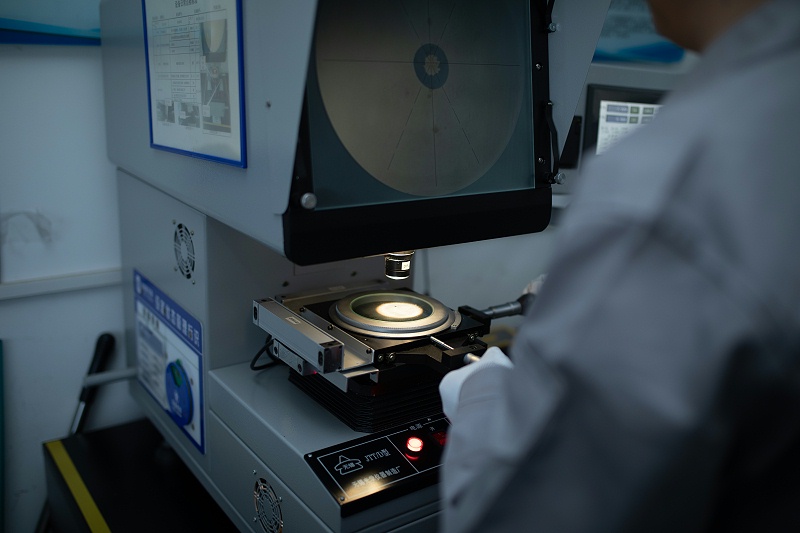
Certificates and test reports provide valuable evidence, but consistent product quality also depends on manufacturing processes.
Consider whether the manufacturer has:
-
Controlled raw material sourcing
-
Standardized production procedures
-
In-process quality inspections
-
Electrical and mechanical testing
-
Traceable quality records
A reliable supplier should be able to explain not only what certifications its products meet, but also how it maintains consistency between production batches.
6. Certification Is Important. But the Right Cable Matters More.
Imagine you are purchasing a flexible cable for an automated production line.
The cable supplier provides a product with UL-related documentation and RoHS compliance.
That sounds promising.
However, the cable is designed for relatively stationary applications, while your equipment requires continuous movement inside a drag chain.
Even if the cable meets the relevant certification requirements, it may not have the mechanical performance needed for your application.
This is why industrial cable selection should never stop at certification labels.
You also need to consider:
-
Bending cycles
-
Minimum bending radius
-
Torsional performance, if applicable
-
Oil and chemical resistance
-
Shielding effectiveness
-
Signal transmission requirements
-
Expected service life
A compliant cable is not necessarily the right cable for every application.
The best purchasing decision combines regulatory compliance, technical suitability, and reliable manufacturing quality.
7. How AEIN Cable Approaches International Cable Manufacturing
At AEIN Cable, we understand that international cable procurement involves more than finding a product with an attractive price.
Buyers need cables that meet project specifications, satisfy applicable standards, and perform reliably in real working environments.
As a specialized cable industry trade–manufacturing integrated company, AEIN focuses on the development, manufacturing, and export of cables for international industrial applications.
Our product range includes:
-
Power Cables
-
Drag Chain Cables
-
Servo Cables
-
Control Cables
-
Robot Cables
-
Reel Cables
We pay attention to product construction, material selection, manufacturing processes, and quality inspection to support the requirements of different industrial applications.
We also understand that certification and compliance requirements vary between markets and projects.
That is why we encourage customers to communicate their required standards, technical specifications, and application conditions before selecting a cable.
Whether you are sourcing cables for industrial automation, machinery manufacturing, or an international engineering project, choosing the right cable starts with understanding what your project actually needs.
At AEIN, we believe that every meter of cable should be built to meet its intended requirements — and quality should be something customers can verify, not just something manufacturers promise.
Final Thoughts
UL, CE, and RoHS are important labels in international cable procurement, but they tell you different things.
-
UL: Has the product been evaluated against applicable safety requirements?
-
CE: Does the product conform to the relevant EU legislation?
-
RoHS: Does the product meet applicable restrictions on hazardous substances?
Understanding these differences can help you avoid misleading certification claims, select more suitable products, and reduce potential compliance risks.
But remember: certification is only one part of cable quality.
The right cable is one that meets the required standards, matches your working environment, and delivers reliable performance throughout its service life.
Looking for cables that meet your project's technical and compliance requirements?
Contact AEIN Cable to discuss your application, specifications, and cable sourcing needs.
AEIN Cable — Reliable Cables. Trusted Manufacturing.